Two companies with identical revenue curves can be in entirely different shape. One grows because it can afford its own development. The other grows because it keeps deferring what it does not want to pay for. The difference often shows up in the accounts only once it has become expensive.
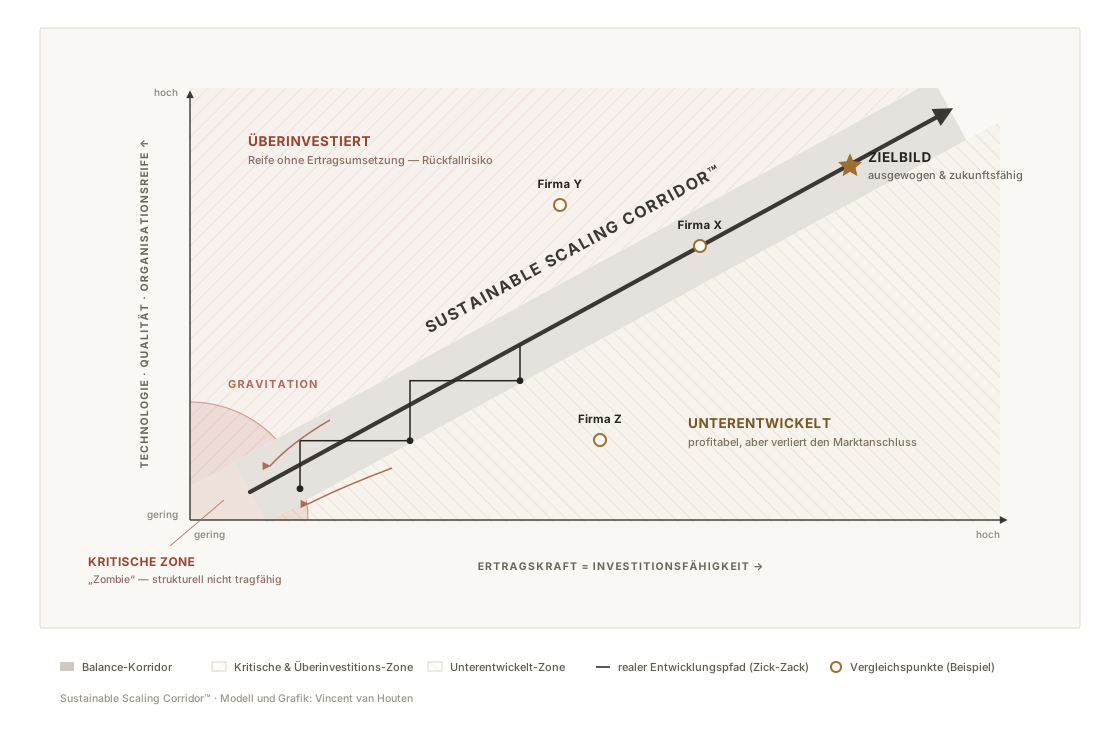
The Sustainable Scaling Corridor makes it visible earlier. The model plots two forces against each other. Horizontally, earnings power: how much economic strength is available to finance development at all? Vertically, operational maturity: how future-proof are technology, process quality, leadership and organisation? Durable enterprise value only arises where the two keep pace. The diagonal along which they do is the corridor.
What matters is not which quadrant a company sits in, but its distance from the line and its direction of travel over time. Leaving the corridor means landing in one of three positions.
Above the line — over-invested. Plenty of technology and quality, too little earnings. The substance exists, it simply is not monetised. Such businesses burn capital and consider themselves innovative.
Below the line — under-developed. Profitable today, but the substance is ageing: the melting cash cow. This is the most common position in the German Mittelstand and the hardest to communicate, because the numbers look good until they do not.
Bottom left — the critical zone. Weak on both axes: no earnings power to invest, and not the maturity required to earn it. The corridor only begins once a company has left this zone.
The real path is never straight. Companies zigzag around the line, each step correcting the last — and throughout, a constant pull works back towards the bottom left. Standing still is not a position; it is a direction.
In practice it is four steps: establish your current position, including relative to competitors. Derive the target picture, with characteristics and metrics for your industry. Set priorities and concrete measures for the next step. Then start again.
The real value lies not in the classification itself, but in what follows from it: the model answers where a company's scarcest resource belongs — the attention of leadership.
And investment almost never means technology. It means: the right second management level. Processes that people actually follow. A culture in which commitments count. That is the expensive and slow part. It does not appear in any asset schedule — and it decides whether a company can carry the next step in growth.
Those above the line therefore do not need another expansion stage, but people who can sell what has already been built. Those below it have to build leadership even though the numbers give no reason to do so. Both run against instinct, because the model almost always points away from what an organization is already strong at. That is where its return lies: not in diagnosis, but in prioritization.
In advisory mandates, we use it accordingly where an organization is trailing its own growth and no one can say precisely why.
The model was not developed at a desk. It came out of building a company from 25 to around 200 people across seven transactions. The three failure positions are not theory. We have sat in all three.